Introduction
Kees de Boekhouder is the go-to accounting firm for freelancers. With ambitious growth goals, the brand decided to significantly scale up its digital marketing activities. More channels, more budget—but also more complexity. To enable data-driven decision-making with real business impact, Kees de Boekhouder turned to Draft Digital.
The problem: Growth without insight leads to noise
To accelerate growth, heavy investments were made in a broader media mix: from SEA (PMAX and non-branded) to display and social advertising on TikTok and Meta. While this increased reach and reduced the brand’s dependence on word-of-mouth, lead quality declined at the same time.
Two challenges emerged:
- No insight into which ads were responsible for the decline in lead quality.
- Push channels like display and social generated few direct leads, yet claimed a large share of conversions—without GA4 being able to measure their real impact.
In short: the true value of each channel remained invisible.
The solution: AI-driven attribution via Billy Grace
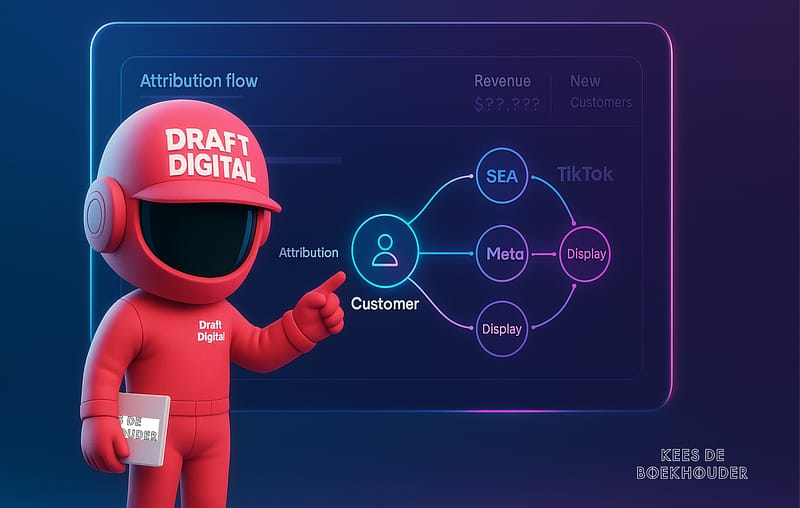
Together with Draft Digital, an innovative solution was implemented: an integration between the HubSpot CRM system and the Billy Grace AI platform. This provided full visibility into the customer journey, including:
- Linking marketing data and sales data
Through dynamic parameters, every touchpoint was captured. When someone schedules a call, this data is linked to HubSpot—and updated again once the lead becomes a customer. - Session stitching & lead journey tracking
Billy Grace recognizes unique customer journeys and uses data-science models to assign value to each channel based on actual impact. - UMM model with impression attribution
Channels focused on qualitative reach and fewer direct website clicks (such as display or TikTok) were finally valued through marketing mix modeling—something that GA4 cannot do.
“The beauty of this case is that we used smart technology to remove the clutter from performance marketing. No more assumptions—only action based on what truly works.”
— Aliks Roling, Digital Marketing Consultant at Draft Digital
The result: deep insights, better decisions, higher conversions
The integration delivered surprising insights and direct control over lead quality.
KPI results at a glance
- TikTok generated 400% more leads than GA4 previously attributed.
- 34% of conversions previously marked as “Direct” were now correctly assigned to other channels.
- Meta generated 40% more leads than initially measured.
- Branded search saw a 10% decrease in attributed value, while non-branded search decreased by 20%.
Lead quality by channel
- Direct traffic: index 133
- Branded channels: index 108
- Push channels: average index 71
- TikTok: a standout performer with an index 217
One of the most important insights from the connection between marketing and sales data is the impact of branding on conversion rates. Where the focus previously lay mainly on direct conversions from performance channels, the new data shows that the strength of a strong brand directly increases the effectiveness of all marketing efforts.
The more specifically someone searches for “Kees de Boekhouder,” the higher the likelihood that they will actually become a customer. Branded search terms and direct traffic—both indicators of brand awareness and brand preference—consistently generate higher conversion rates than push-oriented channels.
This confirms the strategic importance of branding: creating awareness, building trust, and staying top-of-mind ultimately lead to better performance across every channel in the funnel. Branding is therefore not a cost center, but a lever for performance.
A deep dive into the SEA keywords also showed that certain high-intent keywords—despite having a relatively high cost per lead—perform strongly on the KPI “Cost per Client.” This indicates that we need to manage the flow of HubSpot data to the marketing channels more intelligently.
“With this data-driven approach, we’ve taken the first clear steps toward understanding our growth opportunities. We can now better see what does and doesn’t work—not just per channel, but also in the quality and conversion of leads. That gives us a strong foundation to optimize even more precisely in the coming period. I look forward to taking those next steps together.”
— Daniël Muller, Head of Growth at Kees de Boekhouder
Next steps: turning insights into automated growth
Now that the impact of each channel has been clearly mapped out, the focus shifts to translating these insights into a more efficient, data-driven marketing approach. In the coming period, Kees de Boekhouder will focus on three pillars to drive further growth:
1. Smart budget allocation based on real performance
Thanks to the connection between marketing data and sales data, optimization no longer focuses solely on cost per lead (CPL), but on cost per client — the KPI that truly matters. With the help of automation, budgets are dynamically adjusted:
- Channels with a low CPL and high conversion rate automatically receive more budget.
- Channels with lower lead quality or higher costs are scaled down or optimized.
- Campaigns are optimized based on cost per client, which allows for a stronger focus on high-intent keywords.
This performance-driven approach ensures that every marketing euro delivers maximum results and contributes directly to growth ambitions.
2. Larger investments in branding
The analyses show that brand awareness has a direct impact on conversions. People actively searching for Kees de Boekhouder convert significantly better than cold traffic. Therefore, intentional investments are being made in branding campaigns focused on visibility, trust, and top-of-mind presence within the target audience.
The goal: bring more people into the funnel who are already familiar with the brand, so that performance channels also deliver stronger results.
3. Targeted growth through social content
The remarkably high lead-to-client conversion rate on TikTok (52%) demonstrates that this channel holds substantial untapped potential. In the coming period, the focus will be on a strategic content approach dedicated to TikTok and other social channels.